Price Swing Strategy
By Samantha Baltodano
TL;DR:
The Price Swing strategy is a swing trading technical indicator that can help traders identify buy and sell points for trades. The strategy uses four types of swings - Pivot High-Low, Bollinger Bands crossover, RSI Crossover, and RSI + Higher Low/Lower High - to generate signals for entering and exiting trades. These signals are based on technical indicators such as pivot points, Bollinger Bands, and RSI.
When the strategy generates a signal to enter a trade, it uses simulated buy-to-open or sell-to-open orders. The strategy also provides exit points for trades, which are triggered after a specified time period. The Price Swing strategy can be a useful tool for swing traders who are looking to take advantage of short-term price swings in financial assets.
What Is The Price Swing Strategy?
The Price Swing strategy is a swing trading technical indicator that uses four types of swings to identify buy and sell points for trades.
The four types of swings are:
- Pivot High-Low,
- Bollinger Bands crossover,
- RSI Crossover, and
- RSI + Higher Low/Lower High.
Let’s explain these in more detail.
The Pivot High-Low swing is a basic pivot point detection method. An upswing is detected if the low price first falls below its previous value, but then rises. Conditions for the downswing are the opposite, based on the high price.
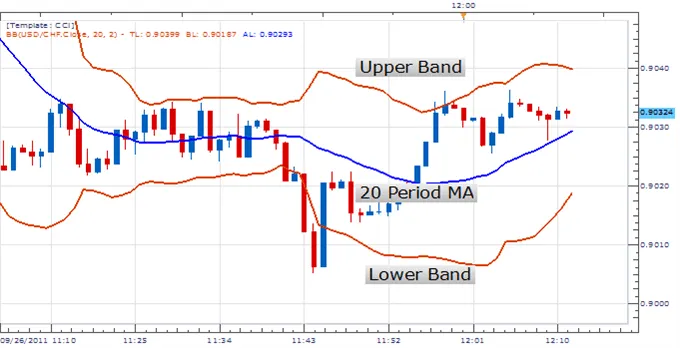
The Bollinger Bands crossover swing is detected when the price crosses above the lower plot of the Bollinger Bands for an upswing and below the upper plot of the Bollinger Bands for a downswing.
The RSI Crossover swing is detected when the RSI crosses above the oversold level (default value of 40) for an upswing, and below the overbought level (default value of 60) for a downswing.
Finally, the RSI + Higher Low/Lower High swing is detected when the current low price is greater than its previous value while the RSI is below oversold, and when the current high price is less than its previous value while the RSI is above overbought.
The Math Behind the Price Swing Strategy
The Price Swing strategy uses simulated buy-to-open orders for upswings and sell-to-open simulated orders for downswings. The strategy also provides exit points for trades when a specified period of time elapses, which defaults to 20 bars.
The strategy also uses technical indicators, such as pivot points, Bollinger Bands, and the RSI, to identify swings in the price of the asset being traded. These technical indicators are used to generate signals that indicate whether to enter or exit a trade.
Trade signals Generated By The Price Swing strategy
The Price Swing strategy generates trade signals based on the four types of swings and the technical indicators used to identify them.
An upswing signal is generated when the price crosses above the lower plot of the Bollinger Bands or the RSI crosses above the oversold level. A downswing signal is generated when the price crosses below the upper plot of the Bollinger Bands or the RSI crosses below the overbought level.
In addition to these signals, the strategy also uses pivot points and the RSI + Higher Low/Lower High swing to generate entry and exit signals. An entry signal is generated when a pivot point is reached, and an exit signal is generated when the specified period of time elapses.
Test The Price Swing Strategy
Great news!
You can back test this exact strategy on historical data for any of your favorite symbols using TradingView.
This strategy has already been built and all you have to do is log in and take it for a spin. You can access this indicator here.
If you’re new to back testing and to TradingView, don’t worry. I created a step-by-step guide you can follow to begin testing the Price Swing Strategy.
Summary
- The Price Swing strategy uses four types of swings to identify buy and sell points for trades: Pivot High-Low, Bollinger Bands crossover, RSI Crossover, and RSI + Higher Low/Lower High.
- Technical indicators such as pivot points, Bollinger Bands, and RSI are used to generate signals for entering and exiting trades.
- Simulated buy-to-open or sell-to-open orders are used when the strategy generates a signal to enter a trade.
- Exit points for trades are provided based on a specified time period.
- An upswing signal is generated when the price crosses above the lower plot of the Bollinger Bands or the RSI crosses above the oversold level.
- A downswing signal is generated when the price crosses below the upper plot of the Bollinger Bands or the RSI crosses below the overbought level.
- The Price Swing strategy can be useful for swing traders looking to take advantage of short-term price swings in financial assets.
Price Swing is just one of many strategies that Archaide automates. For a full list of strategies and studies available click here.
Like what you read? Check out the rest of our content!